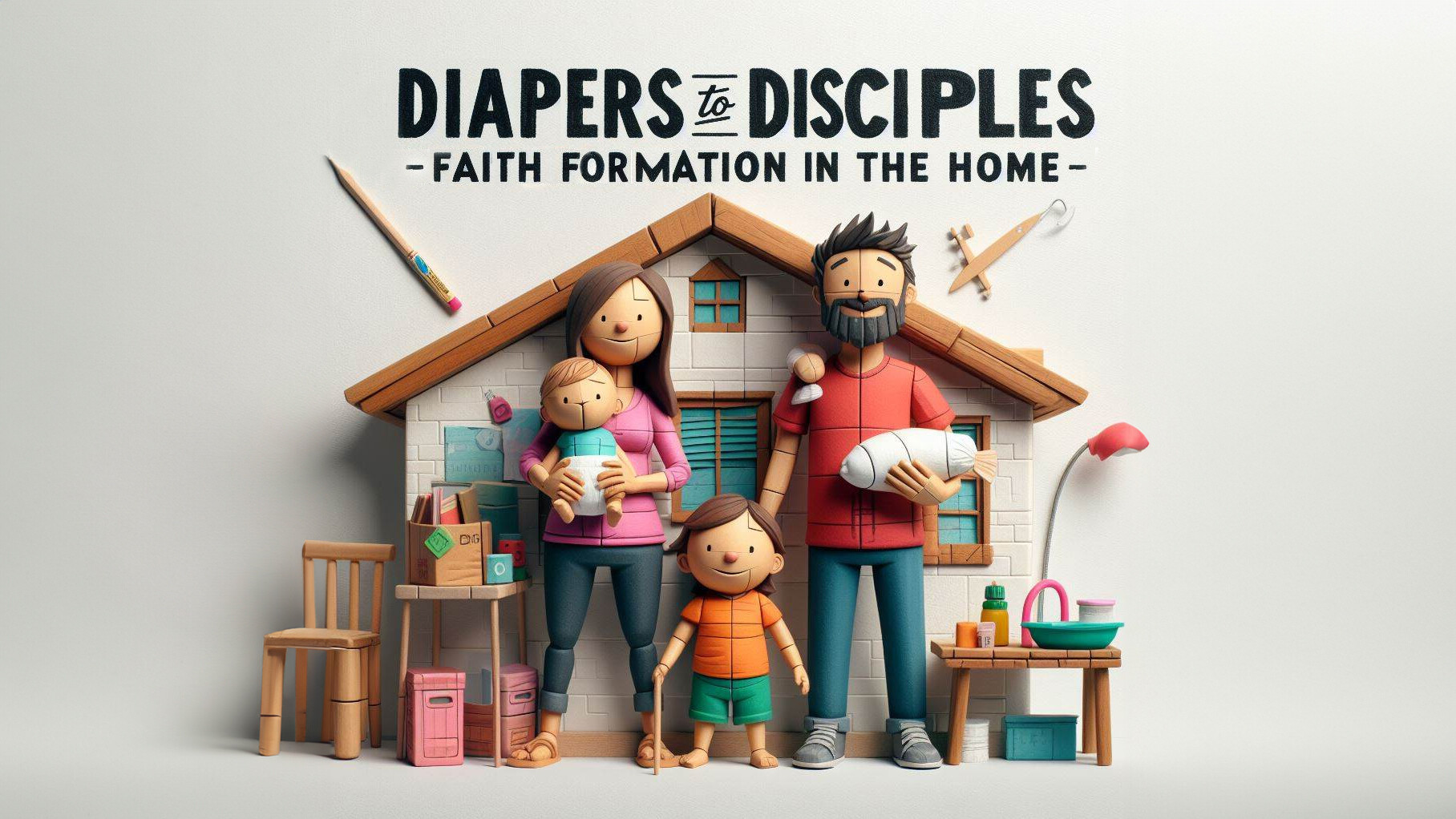
Diapers to Disciples: Faith Formation in the Home
It’s 3 AM, and the sweet sound of a newborn’s cry pierces the silence of the night. Bleary-eyed and sleep-deprived, two parents engage in the age-old dance of ‘not it.’ As they playfully bicker over whose turn it is to tackle the dreaded diaper duty, they’re unknowingly stepping into their first lesson of faith formation—trial by fire.
Just like deciphering the art of the perfect diaper swaddle, navigating the waters of faith formation for their little one can seem just as daunting. Parents may not start as experts in theology or child psychology, but they’ve been perfectly equipped by God with the most critical tool: love. And it’s through this love of Christ, mixed with a healthy dose of patience and humor, they begin the beautiful journey of guiding their child’s path in the faith.
As parents chuckle at the thought of the diaper duel, we remember the hands which fumble with onesies and baby wipes are the very hands the Holy Spirit will use to mold a child’s understanding of faith, hope, and love.
From Diapers to Disciples: The Family’s Faithful Foundation
As parents begin to master the art of the midnight diaper change, they’re also stepping into their divinely appointed roles as their child’s first faith educators. The Bible lays the groundwork in Deuteronomy 6:6-7, where it commands:
And these words that I command you today shall be on your heart. You shall teach them diligently to your children, and shall talk of them when you sit in your house, and when you walk by the way, and when you lie down, and when you rise.
This passage isn’t just ancient text; it’s the divine blueprint for ‘homegrown’ faith. In the New Testament, Paul reminds fathers they're supposed to, "bring [your children] up in the discipline and instruction of the Lord." (Ephesians 6:4, ESV).
Research from Pew and Barna supports this Biblical principle with hard data. According to Pew Research, teens mirror their parents’ religious habits, attending services and engaging in family rituals. Barna Group’s findings echo this, revealing that the family environment is pivotal in shaping a child’s faith journey.
73% of teens give the same answer as their parent about how important religion is to the parent, and 68% of parents give the same answer about how important religion is to their teen.
- Pew Research Center
So, while the church has Sunday school and youth groups, it’s the family which has ‘everyday school.’ Here the faith is woven into the fabric of everyday life, from morning prayers mixed with pancake batter to bedtime blessings tucked in with the sheets (yes, even those teens!). The family doesn’t just pass on the faith; it's infused into every moment, making it as natural as asking, “Who’s on diaper duty tonight?”
We Beg Your Pardon: A Church's Apology
In recent history, the church has taken on the place where children go to "learn about God." This hasn't been the case historically. While church was always the focal point of the family's routine (Sunday Worship) education of the children in the faith belonged to the parents. It's time the church said... “Folks, we’ve had a revelation—and it’s not just the book at the end of the Bible!”
The church has been all-to-overeager to up stage parents in the role of faith formation. The church has monopolized the role of passing on the faith to the next generation, but in scripture this job has been the role of the parents. In all reality, the church's time with your child is limited compared to the amount of time you spend with your children.
The church gets one hour (two at best) with your children and teens in a given week. This leaves a remaining 167 hours in a week. Take away time for sleep and care, that leaves 111 hours in the week for you as parents to mold and shape children and teens in the faith. Parents have an exponentially greater impact on their children than any pastor, teacher, or DCE could ever have.
A Committed Relationship: Both Church and the Home
Now, we have established biblically and practically parents are the primary faith educators, we recognize it's impossible to do it alone. We want to encourage you with this truth - you're not in it alone. As parents, mother and father, you have each other to support, encourage, and pray for each other.
It may feel like teaching the faith to your children is difficult and you don't know where to start, just like the first nights after you brought home your oldest child. It can feel like you're not equipped, exhausted, and lost, but just at the right moment, your spouse comes in and provides you some much needed respite.
That's how the church and the home are supposed to complement each other while caring for the souls of our beloved children. Just as committed parents work together to care for their newborn, so the church and the home need to work together to raise these children with a firm foundation of the Gospel.
The church provides a community in which families can connect, love, and support each other. Beyond that community, the church provides much needed respite for the weary souls of parents who are exhausted caring for their children and worrying how many times they've failed. The church gives out peace and forgiveness through the pure proclamation of the Gospel, and spiritual nourishment in the Sacraments. Here parents can recharge and get the support they need to be the parents God has called them to be.
Walking Together: Faith in the Home
As every relationship and marriage develops, it takes time to understand the personal quarks and nuances which make each member unique. You learn each other's strengths and weaknesses, and the ways you can best support, love, and encourage each other. We're asking we approach the relationship between church and parents the same way.
We both deeply care about the faith your children have in Jesus Christ. It is an honor for me to care for your children. Just like a great marriage takes time, commitment, communication and ultimately love. Lots of love, and forgiveness too. (1 Peter 4:8). I ask we give each other the same. We commit to each other in raising your child in the faith, together. Neither of us can do it alone.